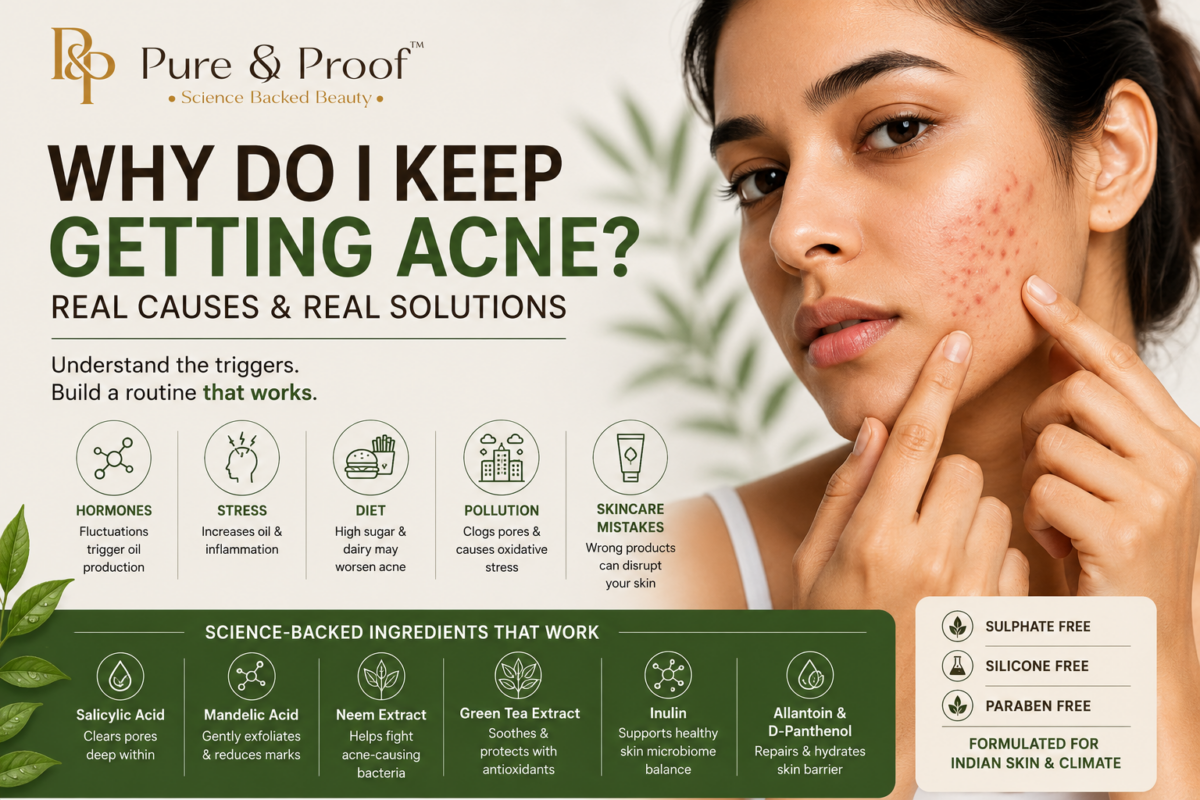
Acne causes and solutions are one of the most searched skincare topics today. Many people struggle with breakouts because of hormones, stress, poor diet, or incorrect skincare routines.
By Pure & Proof Team · Skincare Science · 9 min read
You wash your face every day. You have switched products more times than you can count. You have tried spot treatments, home remedies, and everything in between. Yet the breakouts keep coming back — sometimes in the same spots, sometimes new ones entirely.
You are not doing something wrong. You just have not found the real cause yet.
At Pure & Proof, we believe that clear skin starts with understanding — not guesswork. So let us break this down, cause by cause, and give you solutions that are actually backed by science. best acne causes and solutions guide
How Acne Actually Forms
Before addressing causes, it helps to understand what is happening beneath the surface.
Acne forms through a predictable sequence. Your skin produces excess sebum. Dead skin cells do not shed properly. Both combine inside the pore, creating a blockage. Acne-causing bacteria — Cutibacterium acnes — multiply in that blocked environment. Your immune system responds with redness, swelling, and inflammation.
The result depends on depth and severity: blackheads, whiteheads, papules, pustules, or deep cystic nodules.
The question is not what acne is — it is what is triggering that sequence in your skin specifically.
Understanding acne causes and solutions can help you prevent future breakouts naturally. The right skincare routine, healthy diet, and stress management are important acne solutions for clear skin.
The Real Reasons Your Acne Keeps Returning
1. Hormonal Fluctuations
This is the most common cause of persistent acne — particularly in adults.
Androgens, including testosterone, stimulate the sebaceous glands to produce more oil. When androgen levels rise, your pores are more likely to become congested. This explains why breakouts flare around menstrual cycles, during pregnancy, under chronic stress, or with conditions like PCOS.
Hormonal acne tends to appear along the lower face — jawline, chin, and neck — and often follows a monthly pattern.
The solution here is twofold. Internally, hormonal balance may need medical attention if cycles are irregular or if acne is severe. On the skin, consistent use of anti-inflammatory and sebum-regulating actives — particularly Salicylic Acid and Green Tea Extract — helps manage the surface consequences of hormonal shifts.
2. The Wrong Cleanser
The first and most overlooked step in any routine. Using the wrong face wash does not just fail to help — it can actively make acne worse.
Harsh sulphate-based cleansers strip the skin of its natural oils. In response, the skin overcompensates by producing even more sebum — a phenomenon called the rebound effect. Heavy cream cleansers designed for dry skin leave a residue that clogs pores on oily skin. Products containing silicones create a film that traps impurities beneath the surface.
The right cleanser for acne-prone skin should be sulphate-free, non-comedogenic, and formulated with proven actives that work at the pore level — not just on the surface. The Pure & Proof Clarifying and Renewing Face Wash uses a gentle, plant-based surfactant system (Coco Glucoside and Decyl Glucoside) combined with Salicylic Acid and Mandelic Acid. It cleans deeply without disrupting the barrier — which is the standard your daily cleanser should be held to.
3. Chronic Stress
Stress triggers the release of cortisol — a hormone that signals the skin to produce more oil and amplifies inflammatory responses throughout the body. This is why breakouts tend to appear before important events, during difficult life periods, or after extended sleep deprivation.
Beyond oil production, chronic stress slows skin repair, weakens immune response, and increases the likelihood of picking at existing blemishes — all of which worsen acne.
Skincare cannot fully compensate for systemic stress, but anti-inflammatory ingredients like Aloe Vera Extract, Allantoin, and Green Tea Extract help keep the skin calm even when cortisol levels are elevated.
4. Diet and Gut Health
Research increasingly supports a connection between diet and acne.
High-glycaemic foods — refined sugar, white bread, processed snacks — spike insulin levels, which in turn drive androgen production and sebum output. Dairy, particularly skimmed milk, has been linked to acne in several studies, possibly due to its hormonal content. Gut microbiome imbalances can cause systemic inflammation that manifests on the skin.
Reducing processed foods and refined sugar while increasing antioxidant-rich whole foods is a meaningful intervention. On the skin side, prebiotic ingredients like Inulin — present in the Pure & Proof formulation — support the skin’s surface microbiome, helping maintain a healthy bacterial balance that naturally resists acne-causing pathogens.
5. Inadequate Sleep
Sleep is the body’s primary recovery window. During deep sleep, growth hormone production peaks, skin cells regenerate, and inflammation is regulated. When sleep is consistently insufficient, cortisol rises, cell turnover slows, and the skin’s ability to fight bacteria decreases.
The practical consequence: dead skin cells accumulate faster than they shed, pores clog more readily, and existing breakouts take longer to heal.
Cleansing properly at night — before the skin enters its repair phase — is particularly important for acne-prone skin. The day’s accumulation of oil, pollution, and bacteria should not sit on your skin while it tries to recover overnight.
6. Touching the Face and Environmental Transfer
Every time your hands contact your face, bacteria, oil, and environmental debris transfer directly to your pores. This is one of the most underestimated triggers of persistent breakouts.
Related contributors include dirty pillowcases, which accumulate oil and bacteria over time; phone screens, which are pressed against the cheek and jaw regularly; and friction from helmets, masks, or tight collars — a condition known as acne mechanica.
Changing pillowcases every two to three days, cleaning phone screens daily, and building awareness of habitual face-touching can make a measurable difference alongside your skincare routine.
7. Climate and Urban Pollution
For those living in Indian cities, environmental factors are a significant and frequently ignored acne trigger.
Pollution particles — PM2.5 and particulate matter — settle on the skin and penetrate into pores, triggering oxidative stress and inflammation. Humidity accelerates sebum production and creates conditions where bacteria thrive. Hard water, common in many Indian regions, leaves mineral deposits that can disrupt skin pH and irritate the barrier.
Antioxidant-rich ingredients like Green Tea Extract and Neem Extract work specifically against pollution-induced free radical damage on the skin’s surface. This is why botanicals with documented antioxidant activity are not cosmetic additions to a formula — they are functional.
8. Underlying Health Conditions and Medications
When acne is severe, resistant to topical treatment, and tied to other symptoms, it may reflect a systemic issue. PCOS, thyroid disorders, and adrenal imbalances can all produce hormonal acne as a visible symptom. Certain medications — including corticosteroids, lithium, and some B vitamin supplements — can also trigger breakouts as a side effect.
If your acne is persistent despite a consistent, well-formulated routine, a consultation with a dermatologist or endocrinologist is the right next step. Topical skincare addresses the skin’s surface — systemic conditions need systemic solutions.
Causes at a Glance
| Cause | Primary Mechanism | What Helps |
|---|---|---|
| Hormonal fluctuations | Excess sebum production | Salicylic Acid, Green Tea Extract |
| Wrong cleanser | Barrier disruption, rebound oiliness | Sulphate-free, dual-acid cleanser |
| Chronic stress | Cortisol-driven oil and inflammation | Anti-inflammatory actives, routine consistency |
| Diet and gut health | Insulin spikes, microbiome imbalance | Low-GI diet, prebiotic skincare |
| Poor sleep | Slow cell turnover, reduced immunity | Night cleansing, barrier-supportive routine |
| Face touching and transfer | Bacterial contamination of pores | Hygiene habits, pillowcase changes |
| Pollution and humidity | Oxidative stress, pore congestion | Antioxidant actives, twice-daily cleansing |
| Underlying conditions | Systemic hormonal or inflammatory response | Dermatologist consultation |
“Acne is not a cleanliness problem. It is a biological one — and solving it requires addressing the biology, not just the surface.”
What Your Cleanser Needs to Actually Do
The cleanser is where every routine begins. If it is wrong, every step that follows is compromised.
An effective face wash for acne-prone skin should remove excess oil and impurities without stripping the barrier, deliver actives that work inside the pore — not just on the surface — and include ingredients that support healing and microbiome balance alongside exfoliation.
The Pure & Proof Clarifying and Renewing Face Wash is formulated around exactly this principle. Its dual-acid system — Salicylic Acid for pore-deep oil dissolution and Mandelic Acid for gentle surface renewal and PIH prevention — is supported by Neem Extract and Green Tea Extract for bacterial control and antioxidant protection. Allantoin and D-Panthenol repair and hydrate the skin barrier after actives have done their work. Inulin maintains surface microbiome balance for long-term resilience.
No sulphates. No silicones. No parabens. Clinically proven actives in a formula built for Indian skin conditions.
The Verdict
Recurring acne is rarely caused by a single factor. In most cases, it is the combination of hormonal activity, environmental exposure, lifestyle habits, and skincare choices — all reinforcing each other.
The solution is not a single miracle product. It is a systematic approach: understanding your specific triggers, building a routine that addresses them at every level, and giving that routine the consistency and time it needs to work. Skin cycles are 28 to 30 days. Real results follow real commitment.
Start with the right cleanser. Build from there.
Frequently Asked Questions
Why do I still get acne as an adult if I thought it was just a teenage problem?
Adult acne is extremely common and often driven by different causes than teenage acne. Hormonal fluctuations, stress, dietary habits, and environmental exposure all become more significant contributors in adulthood. The sebaceous glands remain responsive to hormonal signals throughout life, which is why breakouts can persist well into the 30s and beyond.
How long does it take for a new face wash to show results?
A minimum of four to six weeks is needed before evaluating any new cleanser. The skin’s cell turnover cycle takes approximately 28 to 30 days, meaning visible improvements require at least one complete renewal cycle. Consistency over this period is more important than the frequency of product switching.
Can over-washing my face make acne worse?
Yes. Washing more than twice a day strips the skin of its natural lipid barrier, triggering increased sebum production as a compensatory response. Twice daily — morning and night — is the recommended frequency for acne-prone skin.
Why does my acne get worse just before my period?
In the days before menstruation, progesterone levels rise and oestrogen drops. This hormonal shift stimulates the sebaceous glands to produce more oil and promotes inflammation in the skin. Salicylic Acid-based cleansers and anti-inflammatory botanicals can help manage the surface effects of this predictable hormonal cycle.
Is it necessary to moisturise if I already have oily, acne-prone skin?
Yes — skipping moisturiser is a common mistake. When the skin is dehydrated, it compensates by producing more sebum, which worsens congestion. A lightweight, non-comedogenic moisturiser maintains hydration levels without clogging pores, supporting the skin barrier and reducing reactive oiliness over time.
Can the same face wash work for both morning and night cleansing?
Yes, provided it is formulated gently enough for daily use. A sulphate-free cleanser with active ingredients like Salicylic Acid and Mandelic Acid is designed for twice-daily use without causing over-exfoliation or barrier disruption.
Should I exfoliate separately if my face wash already contains acids?
If your face wash contains Salicylic Acid or Mandelic Acid, you are already receiving a low-level exfoliation with every cleanse. Adding a separate high-concentration exfoliant on top increases the risk of barrier damage and irritation. Introduce additional exfoliants cautiously — and always patch test first.
Clear Skin Starts Here
The Pure & Proof Clarifying and Renewing Face Wash combines Salicylic Acid and Mandelic Acid in a single gentle daily cleanser — formulated specifically for acne-prone and combination skin in Indian conditions.
Twice a day. Consistently. That is where it begins.
https://pureandproof.com/chemical-exfoliation-vs-physical-scrubs-which-one-wins-2/