Pure & Proof · Science Meets Skin
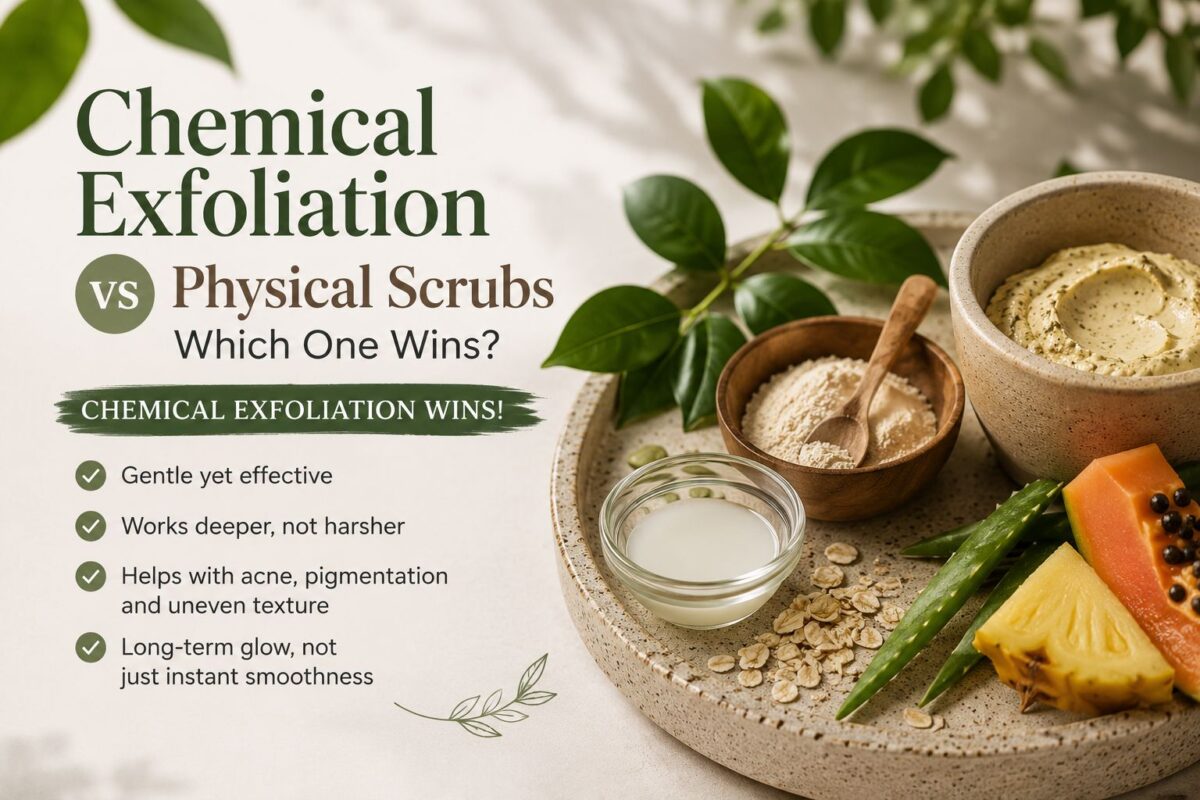
Chemical Exfoliation vs Physical Scrubs
Which One Wins?
By Pure & Proof Team · Skincare Science · 8 min read
You’ve probably stood in front of a skincare shelf wondering — should I get a scrub or a chemical exfoliant? Both promise smoother, brighter skin. Both are wildly popular. But they work in completely different ways, and choosing the wrong one for your skin type can do more harm than good.
At Pure & Proof, we believe skincare decisions should be backed by science — not just aesthetics or trends. So let’s settle this debate once and for all.
What Is Physical Exfoliation and chemical Exfoliation ?
in the race of chemical exfoliation vs physical scrub first learn what is the meaning of both and then decide which one is win between race of chemical exfoliation vs physical scrub
Physical exfoliation uses manual friction to slough off dead skin cells from the surface. Think grainy scrubs, exfoliating brushes, loofahs, or textured cleansing pads. You apply the product, rub it in circular motions, and the particles mechanically dislodge dead cells.
Common physical exfoliants you’ll find on the market:
- Sugar or salt granules
- Walnut shell powder
- Rice bran particles
- Pumice
- Microbeads (now largely banned due to environmental harm)
The appeal is obvious — physical scrubs feel satisfying. You can feel them working. That immediate tactile smoothness makes people feel like they’ve thoroughly cleaned their skin. But that feeling can be deceiving, as we’ll explain below.
Chemical exfoliation uses active acids or enzymes to dissolve the bonds that hold dead skin cells together — allowing them to shed naturally without any physical force. No scrubbing required. There are three main categories:
AHAs (Alpha Hydroxy Acids) — Surface Refiners
AHAs like Glycolic Acid, Lactic Acid, and Mandelic Acid work primarily on the skin’s surface. They’re water-soluble and excellent for improving skin texture, combating dullness, fading dark spots, and addressing dry or sun-damaged skin.
BHAs (Beta Hydroxy Acids) — Pore Specialists
Salicylic Acid is the most well-known BHA. Because it’s oil-soluble, it can travel through sebum directly into the pore lining — dissolving the congestion that causes blackheads, whiteheads, and acne from the inside out. It also carries natural anti-inflammatory properties, which helps reduce active breakouts.
Enzymes — The Gentlest Option
Derived from fruits like papaya (Papain) and pineapple (Bromelain), enzyme exfoliants offer a very mild chemical exfoliation with virtually no irritation risk — ideal for skin that can’t tolerate acids at all.
“No matter how hard you scrub the surface, physical exfoliants cannot reach inside the pore. Chemical actives work where it actually matters.”
Head-to-Head: Chemical vs Physical Exfoliation
| Factor | Physical Scrubs | Chemical Exfoliation |
|---|---|---|
| Mechanism | Friction / manual removal | Acid dissolves dead cell bonds |
| Depth of Action | Surface only | Surface + deep inside pores |
| Irritation Risk | High if over-scrubbed | Low when used correctly |
| Blackhead Clearing | Minimal | Excellent (especially BHAs) |
| Results Timeline | Immediate but temporary | Gradual but long-lasting |
| Safe for Sensitive Skin | Rarely | Yes (Mandelic Acid) |
| Anti-Aging Benefits | Minimal | Significant — stimulates cell turnover |
| Safe for All Skin Tones | Generally yes | Yes — especially Mandelic Acid |
The Problem With Physical Scrubs
Physical scrubs aren’t inherently evil — but they are frequently misused. Here’s where things go wrong:
⚠️ Uneven Particles Create Micro-Tears
Many drugstore scrubs use crushed walnut shells or irregular granules with jagged, uneven edges. These create tiny micro-tears in the skin — invisible to the naked eye but responsible for long-term redness, sensitivity, and worsened breakouts. The damage is cumulative; you won’t feel it immediately, but your skin will.
⚠️ Over-Scrubbing Is Common
Because scrubs feel so satisfying, people use them too frequently — sometimes daily. This erodes the skin’s natural moisture barrier, triggering overproduction of sebum and increasing sensitivity. You end up oilier and more reactive than before, while thinking you’re being thorough.
⚠️ They Cannot Clear Pores
This is the biggest limitation. No matter how vigorously you scrub the surface, physical exfoliants cannot penetrate inside the pore. If your concern is blackheads, whiteheads, or deep congestion — a scrub is addressing only the very tip of the problem.
Why Chemical Exfoliation Has the Edge
Chemical exfoliation offers precision. Each acid type is engineered for a specific function — no guesswork, no friction damage, no barrier disruption when used correctly.
🧪 Salicylic Acid (BHA) — The Pore Specialist
Salicylic Acid is oil-soluble, meaning it travels through sebum directly into the pore lining. It dissolves the blend of dead cells and oil that causes blackheads and whiteheads at their source. It also carries clinically documented anti-inflammatory properties — actively calming active acne, not just cleaning around it.
Best for: Oily skin · Acne-prone skin · Blackheads · Enlarged pores
✨ Mandelic Acid (AHA) — The Gentle Giant
Mandelic Acid has a significantly larger molecular size than most AHAs — which means it penetrates the skin more slowly, making it one of the most well-tolerated chemical exfoliants available. Despite this gentleness, it exfoliates effectively, brightens the complexion, reduces post-acne dark spots, and is clinically safer for darker Indian skin tones where risk of post-inflammatory hyperpigmentation (PIH) is a real concern.
Best for: Sensitive skin · Combination skin · Hyperpigmentation · Dull complexion · All skin tones
Which One Is Right for Your Skin Type?
Not all skin responds the same way. Here’s a targeted guide:
🛢️ Oily / Acne-Prone Skin
Go with Salicylic Acid. Its oil-solubility and pore-penetrating ability make it far superior to any scrub for congested, breakout-prone skin.
🌸 Dry / Dull Skin
Choose a gentle AHA like Mandelic Acid or Lactic Acid. Chemical exfoliation accelerates cell turnover and restores radiance without stripping your already-compromised moisture barrier.
🤍 Sensitive / Reactive Skin
Skip harsh scrubs entirely. Mandelic Acid is your best option — gentle, effective, and unlikely to trigger a reaction even in reactive skin types.
⚖️ Combination Skin
A targeted dual-acid approach works best — BHA for the T-zone (oily, congested areas) and AHA for drier zones. Never use both on the same day.
🌟 Normal Skin
You have the most flexibility. But for long-term skin health and anti-aging benefits, chemical exfoliation still offers the edge over any scrub.
🍫 Darker Skin Tones
Mandelic Acid is specifically preferred over Glycolic Acid or harsh BHAs. Its larger molecule reduces the risk of irritation and PIH — a crucial concern often overlooked by global skincare brands.
Can You Use Both?
Yes — but strategically. Many people incorporate both into their routine at different times. The rules to follow:
- Never use both on the same day. Double exfoliation is a fast route to barrier damage and irritation.
- Limit physical scrubs to once a week maximum if you’re also using a chemical exfoliant.
- Always follow with moisturiser and SPF — freshly exfoliated skin is more vulnerable to UV damage, especially in Indian sun conditions.
- Introduce chemical exfoliants slowly — start 2–3 times a week and build tolerance over 2–3 weeks before increasing frequency.
Pure & Proof
Why We Choose Chemistry Over Friction
At Pure & Proof, our formulations are rooted in clinical science. We choose Salicylic Acid and Mandelic Acid as our exfoliating actives — not because they’re trendy, but because they are proven, targeted, and safe across skin tones.
Here’s why these two acids sit at the core of everything we formulate:
🧪 Salicylic Acid — Delivers measurable pore-clearing and anti-inflammatory results that no physical exfoliant can replicate
✨ Mandelic Acid — Works at the cellular level, gentle enough for daily use, and safer for Indian skin tones than most alternatives
🌿 Botanical Intelligence — Both are complemented by Prebiotic Inulin, Kiwi Extract, and Green Tea to support barrier health alongside exfoliation
🛡️ No Harsh Particles — No micro-tear risk, no over-stripping, no surface-only results
We’re not against physical exfoliation entirely — a well-formulated gentle scrub used occasionally can be a pleasant addition to your routine. But as your primary exfoliation method? Chemical exfoliants win on science, safety, and long-term skin transformation.
The Verdict — Which One Wins?
Chemical exfoliation wins.
Not because physical scrubs are useless — but because chemical exfoliants offer deeper action, more targeted benefits, lower risk of physical damage, and proven long-term skin improvement. When selected for your specific skin type and used correctly, they are simply the smarter, more scientific approach to exfoliation.
The shift from scrubbing to chemistry isn’t just a skincare trend. It’s an upgrade your skin will thank you for.
Frequently Asked Questions
Is chemical exfoliation safe for daily use?
Most chemical exfoliants are designed for 2–3 times per week, not daily. Over-exfoliation with acids can disrupt the skin barrier and cause increased sensitivity. Always start with a lower frequency and build up gradually over a few weeks.
Can I use a chemical exfoliant if I have very sensitive skin?
Yes — opt for Mandelic Acid (large molecule, slower penetration) or enzyme-based exfoliants. Always patch test on the inner arm before first use on your face, and start with once a week.
At what age should you start exfoliating?
Mild exfoliation can begin in the late teens when natural cell turnover starts to slow. Begin with low-percentage Mandelic Acid before introducing stronger actives like Glycolic Acid or higher concentrations of Salicylic Acid.
Do I need to use SPF after exfoliation?
Absolutely — this is non-negotiable, especially in India’s sun conditions. Exfoliation removes the outermost skin layer, significantly increasing sun sensitivity. Apply SPF 30+ every morning after any exfoliation the night before.
Is Mandelic Acid better than Glycolic Acid for Indian skin?
For most Indian skin tones, yes. Mandelic Acid’s larger molecular size means slower penetration and a significantly lower risk of post-inflammatory hyperpigmentation (PIH) — a common concern for melanin-rich skin. It brightens and resurfaces without the harsh sensitivity that Glycolic Acid can trigger.
Can I combine a BHA and AHA in the same routine?
Yes — but not at the same time in one session. Many people use a BHA (like Salicylic Acid) on some days and an AHA (like Mandelic Acid) on alternate days. This is known as acid cycling and is a well-tolerated approach for combination skin.
Pure & Proof
Smarter Exfoliation Starts Here
Pure & Proof’s Clarifying & Renewing Face Wash combines Salicylic Acid + Mandelic Acid — the exact dual-acid system this article recommends — in a single daily cleanser formulated specifically for Indian skin.
No scrubbing. No harsh particles. Just clinical actives doing precise work, every day.